January 20, 2010

Our technologies have brought us into realities in which there is no time to reflect


Esquire Magazine, February 2010
3,650 Days by Charles P. Pierce

"And the truly ironic thing about it, and the Mayans would have found it more hilarious than anyone else, is that the only true function of these speculative apocalypses is that they serve best as a distraction from - and therefore as protection against - actual catastrophes, which really do come..."

"In a fragmented, accelerated world, there was no way to see these things coming. Our technologies have brought us into realities in which there is no time to reflect, to make the connections between what we knew once and what is happening to us now.

"But the language of the vicarious reality within which we conduct so much of our daily lives - the one in which we can invest ourselves without really involving ourselves - had no vocabulary for what had happened because it had happened in the actual reality."

Interesting essay. Similar to the New York Times "If Your Kids Are Awake, They're Probably Online". It seems our generation is gaining a lot, but losing more.

January 19, 2010

More excerpts coming soon!

Life has been a little crazy. I spent an amazing semester in Florence, Italy. (I did read a great Italian novel while I was there: Io Non Ho Paura by Niccolo Ammaniti, but I didn't find the time to blog about it and not sure it would've been useful to anyone who reads this). I came back and had a relaxing break in NYC and I began reading two books! So my point of this is that there should be more excerpts coming soon from:

Pride and Prejudice, Jane Austen
Everything Is Illuminated, Jonathan Safran Foer
and
Bridget Jones' Diary, Helen Fielding (required reading for an anthropology course, should be interesting).

And I have my hands on a few magazines, so will be quoting from articles I read too, I'm sure.

Till then.

August 29, 2009

Dubliners


I'll have to read this again more thoroughly another time, I only skimmed through a few of the stories. One thing I noticed though, is that James Joyce is really good with description, particularly of his characters.

A Painful Case
"Mr. Duffy abhorred anything which betokened physical or mental disorder. A medieval doctor would have called him saturnine. His face, which carried the entire tale of his years, was of the brown tint of Dublin streets. On his long and rather large head grew dry black hair and a tawny moustache did not quite cover an unamiable mouth. His cheekbones also gave his face a harsh character; but there was no harshness in the eyes which, looking at the world from under their tawny eyebrows, gave the impression of a man ever alert to greet a redeeming instinct in others but often disappointed. He lived at a little distance from his body, regarding his own acts with doubtful sideglances. He had an odd autobiographical habit which led him to compose in his mind from time to time a short sentence about himself containing a subject in the third person and a predicate in the past tense. He never gave alms to beggars, and walked firmly, carrying a stout hazel." (p 108).

July 17, 2009

I had to get a ride that morning with a maniac


"I stumbled out of town with barely enough strength to reach the city limits. I knew I'd be arrested if I spent another night in Harrisburg. Cursed city! The ride I proceeded to get was with a skinny, haggard man who believed in controlled starvation for the sake of health. When I told him I was starving to death as we rolled east he said, 'Fine, fine, there's nothing better for you. I myself haven't eaten for three days. I'm going to live to be a hundred and fifty years old.' He was a bag of bones, a floppy doll, a broken stick, a maniac. I might have gotten a ride with an affluent fat man who'd say 'Let's stop at this restaurant and have some pork chops and beans.' No, I had to get a ride that morning with a maniac who believed in controlled starvation for the sake of health." (p. 106)

haha. and :

"So now Dean had come about four thousand miles from Frisco, via Arizona and up to Denver, inside four days, with innumerable adventures sandwiched in, and it was only the beginning." (p 117)

Only the beginning?! So what were the first 117 pages about? Sorry, Kerouac, but I can't anymore. I hate to leave a book half read but no time to force a book on myself. Not interested in Salvatore's adventures anymore. :)

June 30, 2009

And suddenly nobody's hooting at him any more.


Ooh! I forgot about this one. I'm still reading On the Road, don't worry but this one came to mind tonight after the day's events while wondering why I try so damn hard all the time and it's because I can't live knowing that I didn't. This part is so poignant; I love it in the movie and the book.


"And suddenly nobody's hooting at him any more. His arms commence to swell, and the veins squeeze up to the surface. He clinches his eyes, and his lips draw away from his teeth. His head leans back, and tendons stand out like coiled ropes running away from his heaving neck down both arms to his hands. His whole body shakes with the strain as he tries to lift something he knows he can't lift, something everybody knows he can't lift. But, for just a second, when we hear the cement grind at our feet, we think, by golly, he might do it. Then his breath explodes out of him, and he falls back limp against the wall. There's blood on the levers where he tore his hands. He pants for a minute against the wall with his eyes shut. There's no sound but his scraping breath; nobody's saying a thing. He opens his eyes and looks around at us. One by one he looks at the guys - even at me - then he fishes in his pockets for all the IOU's he won the last few days at poker. He bends over the table and tries to sort them, but his hands are froze into red claws, and he can't work the fingers. Finally he throws the whole bundle on the floor - probably forty or fifty dollars' worth from each man- and turns to walk out of the tub room. He stops at the door and looks back at everybody standing around.
"But I tried, though," he says. "Goddammit, I sure as hell did that much, now, didn't I?"
And walks out and leaves those stained pieces of paper on the floor for whoever wants to sort through them." (p. 110)

June 27, 2009

On The Road


So, I'm a little bit of a cheater. Because I fell in love with this passage way before I knew it was from On The Road, or before I knew it was by Jack Kerouac, for that matter. I had found it online somewhere and thought, that just makes so much sense! & it's beautifully written.


"But then they danced down the streets like dingledodies, and I shambled after as I've been doing all my life after people who interest me, because the only people for me are the mad ones, the ones who are mad to live, mad to talk, mad to be saved, desirous of everything at the same time, the ones who never yawn or say a commonplace thing, but burn, burn, burn like fabulous yellow roman candles exploding like spiders across the stars and in the middle you see the blue centerlight pop and everybody goes "Awww!" (p. 5)


June 20, 2009

All the way to the coast we had fun pretending to be brave.


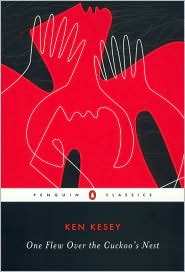
"He'd shown us what a little bravado and courage could accomplish, and we thought he'd taught us how to use it. All the way to the coast we had fun pretending to be brave. When people at a stop light would stare at us and our green uniforms we'd do just like he did, sit up straight and strong and tough-looking and put a big grin on our face and stare straight back at them till their motors died and their windows sunstreaked and they were left sitting when the light changed, upset bad by what a tough bunch of monkeys was just now not three feet from them, and help nowhere in sight. As McMurphy led the twelve of us toward the ocean." (p. 205)

"As I walked after them it came to me as a kind of sudden surprise that I was drunk, actually drunk, glowing and grinning and staggering drunk for the first time since the Army, drunk along with half a dozen other guys and a couple of girls - right on the Big Nurse's ward! Drunk and running and laughing and carrying on with women square in the center of the Combine's most powerful stronghold! I thought back on the night, on what we'd been doing, and it was near impossible to believe. I had to keep reminding myself that it had truly happened, that we had made it happen. We had just unlocked a window and let it in like you let in the fresh air. Maybe the Combine wasn't all-powerful. What was to stop us from doing it again, now that we saw we could? Or keep us from doing other things we wanted? I felt so good thinking about this that I gave a yell and swooped down on McMurphy and the girl Sandy walking along in front of me, grabbed them both up, one in each arm, and ran all the way to the day room with them hollering and kicking like kids. I felt that good." (p. 263)

"He gave a cry. At the last, falling backward, his face appearing to us for a second upside down before he was smothered on the floor by a pile of white uniforms, he let himself cry out: A sound of cornered-animal fear and hate and surrender and defiance, that if you ever trailed a coon or cougar or lynx is like the last sound the treed and shot and falling animal makes as the dogs get him, when he finally doesn't care any more about anything but himself and his dying." (p. 275)