Ghosts
By Dolly Alderton
Time to pull a handful of posts out of the drafts folder...
As desired, I re-read Ghosts earlier this year, in the middle of winter (again). It made me cry (again). It also made me feel tinges of hope and empathy as I further dissected the parallels in Nina George's journey to mine and those of the people I know, as told via Dolly's delicious prose and metaphor.
Ongoing: I continue to contemplate the ghosts of my friendships, romances, and family.
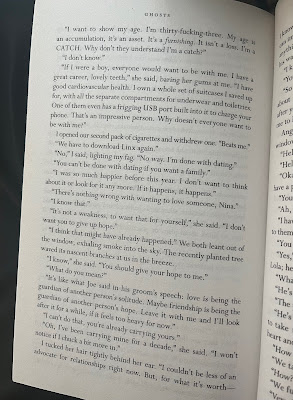 |
This is one of my favorite moments from the novel. I had never consciously considered the ways loved ones (could) hold hope for one another. We've said prayers, but this beautiful exchange felt different. There have been times in my love journey where I lost hope and all I needed was for someone to hold it for awhile. I think some people have.
(p. 296)
|
There was the evidence, in all these profiles, where who we really are and who we'd like everyone to think we are were in such unsubtle tension. How clear it suddenly was that we are all the same organs, tissue and liquids packaged up in one version of a million clichés, who all have insecurities and desires; the need to feel nurtured, important, understood and useful in one way or another. None of us are special. I don't know why we fight it so much.
(p. 32)
The sexiest, most exciting, romantic, explosive feeling in the world is a matter of a few centimeters of skin being stroked for the first time in a public place. The first confirmation of desire. The first indication of intimacy. You only get that feeling with a person once.
(p. 39)
"Big night?" I asked, the note of judgment in my voice as bright and sonorous as a middle C.
(p. 96)
Being a heterosexual woman who loved men meant being a translator for their emotions, a palliative nurse for their pride and a hostage negotiator for their egos.
(p. 98)
There was a daftness that I shared with Joe, and a seriousness that I shared with Max. Both were parts of me and both were true, but both seemed so in conflict with each opposing representative present. I hadn't anticipated that this merging of people meant this merging of selves—it made me think anxiously about myself in a way that was unfamiliar.
(p. 102)
I felt myself lean towards his praise like it was the warmth of sunlight.
(p. 113)
My body responded with more than my senses—I felt it in my cells. It was biological and visceral, prehistoric and predetermining. There in the middle was the garden square, perfectly kept in accordance with every angle my memory had captured.
(p. 116)
In the predawn hours of the next morning, unable to sleep, I went to Dad's bookshelf and picked up his dictionary of English etymology. I sat on the floor, cross-legged, with my back pressed against the sofa, and flipped to N.
Nostalgia: Greek compound combining nostos (homecoming) and àlgos (pain). The literal Greek translation for nostalgia is "pain from an old wound."
(p. 138)
I stayed in front of Marie-Thérèse in her red armchair and examined every part of her exquisitely scrambled form. The impossible positioning of her breasts stacked on top of each other, the surreal placement of her mismatched shoulders. How her face split into two parts, one half of which could be another face kissing the other in profile, if you looked for long enough. Was the second face that Picasso saw symbolic of Marie-Thérèse's hidden multitudes? Or was it his profile—did he imagine he dwelled within her, his lips on her cheek wherever she went? What would it be like, I wondered, to be seen through such adoring eyes, that they could not only capture you in a painting, but rearrange you to further exhibit who you were? I stroked the rounded right angle of where my neck met my shoulder like it was the hand of a lover and thought about being put inside a Rubik's Cube of someone's gaze. I couldn't imagine ever being studied and known like that.
My solitude was like a gemstone. For the most part it was sparking and resplendent—something I wore with pride...But underneath this diamond of solitude was a sharp point that I occasionally caught with my bare hands, making it feel like a perilous asset rather than a precious one.
(p. 185)
As I watched him surrender to the silly, untamable joy of hysterical giggles, I realized that while the future might strip him of his self, something mightier remained. His soul would always exist somewhere separate and safe. No one and nothing—no disease, no years of aging—could take that away from him. His soul was indestructible.
(p. 269)