Showing posts with label friendship. Show all posts

August 13, 2023

I couldn't imagine ever being studied and known like that.

Ghosts
By Dolly Alderton

Time to pull a handful of posts out of the drafts folder...

As desired, I re-read Ghosts earlier this year, in the middle of winter (again). It made me cry (again). It also made me feel tinges of hope and empathy as I further dissected the parallels in Nina George's journey to mine and those of the people I know, as told via Dolly's delicious prose and metaphor.

Ongoing: I continue to contemplate the ghosts of my friendships, romances, and family.

This is one of my favorite moments from the novel. I had never consciously considered the ways loved ones (could) hold hope for one another. We've said prayers, but this beautiful exchange felt different. There have been times in my love journey where I lost hope and all I needed was for someone to hold it for awhile. I think some people have.
(p. 296)

There was the evidence, in all these profiles, where who we really are and who we'd like everyone to think we are were in such unsubtle tension. How clear it suddenly was that we are all the same organs, tissue and liquids packaged up in one version of a million clichés, who all have insecurities and desires; the need to feel nurtured, important, understood and useful in one way or another. None of us are special. I don't know why we fight it so much. 
(p. 32)

The sexiest, most exciting, romantic, explosive feeling in the world is a matter of a few centimeters of skin being stroked for the first time in a public place. The first confirmation of desire. The first indication of intimacy. You only get that feeling with a person once.
(p. 39)

"Big night?" I asked, the note of judgment in my voice as bright and sonorous as a middle C.
(p. 96)

Being a heterosexual woman who loved men meant being a translator for their emotions, a palliative nurse for their pride and a hostage negotiator for their egos.
(p. 98)

There was a daftness that I shared with Joe, and a seriousness that I shared with Max. Both were parts of me and both were true, but both seemed so in conflict with each opposing representative present. I hadn't anticipated that this merging of people meant this merging of selves—it made me think anxiously about myself in a way that was unfamiliar.
(p. 102)

I felt myself lean towards his praise like it was the warmth of sunlight.
(p. 113)

My body responded with more than my senses—I felt it in my cells. It was biological and visceral, prehistoric and predetermining. There in the middle was the garden square, perfectly kept in accordance with every angle my memory had captured.
(p. 116)

In the predawn hours of the next morning, unable to sleep, I went to Dad's bookshelf and picked up his dictionary of English etymology. I sat on the floor, cross-legged, with my back pressed against the sofa, and flipped to N. 
Nostalgia: Greek compound combining nostos (homecoming) and àlgos (pain). The literal Greek translation for nostalgia is "pain from an old wound."
(p. 138)

I stayed in front of Marie-Thérèse in her red armchair and examined every part of her exquisitely scrambled form. The impossible positioning of her breasts stacked on top of each other, the surreal placement of her mismatched shoulders. How her face split into two parts, one half of which could be another face kissing the other in profile, if you looked for long enough. Was the second face that Picasso saw symbolic of Marie-Thérèse's hidden multitudes? Or was it his profile—did he imagine he dwelled within her, his lips on her cheek wherever she went? What would it be like, I wondered, to be seen through such adoring eyes, that they could not only capture you in a painting, but rearrange you to further exhibit who you were? I stroked the rounded right angle of where my neck met my shoulder like it was the hand of a lover and thought about being put inside a Rubik's Cube of someone's gaze. I couldn't imagine ever being studied and known like that.

My solitude was like a gemstone. For the most part it was sparking and resplendent—something I wore with pride...But underneath this diamond of solitude was a sharp point that I occasionally caught with my bare hands, making it feel like a perilous asset rather than a precious one.
(p. 185)

As I watched him surrender to the silly, untamable joy of hysterical giggles, I realized that while the future might strip him of his self, something mightier remained. His soul would always exist somewhere separate and safe. No one and nothing—no disease, no years of aging—could take that away from him. His soul was indestructible.
(p. 269)


June 05, 2022

It's love and someone you love's power growing, and it's watching the elements cater to a woman who exudes.


(proud of the woman I am & the woman I'm still becoming.)


Too Much and Not the Mood
By Durga Chew-Bose

"For twenty dollars—an extravagance I can't afford but can, so in that minute I spend it—we place our palms on metal sensors, have our photo taken with a Kirlian-type camera, and then sit and listen as an employee at Magic Jewelry—who sometimes speaks to us in the first-person plural—interprets the psychedelic colors our aura. Reds and oranges mean one thing—that we've been working too hard, we've been told—and cooler colors signify that we're withdrawn and overthinking, daydreaming and negligent of more earthly forces. Habitually, the both of us are purple. Absent and worn-out. Entombed in thought. A distinguishing quality of the women I love, meaning, none of us are bothered by how infrequently we see one another. We have an arrangement that was never formally arranged. A consideration for turning down invitations. We are happy for the person who is indulging in her space, and how she might merely be spending the weekend unescorted by anything except her own work, which could also mean: she is in no rush to complete much. She is tinkering. She is gathering all the materials necessary for repotting a plant but not doing it. She is turning off the lights and climbing into her head because that's usually the move."
(p. 53)

"The women I love reenter the world so poorly. Their elegance lies in how summarily they'll dodge its many attenuations, advancing alongside the world as if passing their fingers over the rails of a fence and cleverly selecting the right moment to hop over.
They are women who are loveliest when just a little bit haunted or mad as hell on a clear day. Who carefully believe in ghosts and kismet, and are mistrustful of shortcuts. Who laugh like villains. Wake up earliest when the sky is overcast. Who needn't say much for all to know, tonight, they won't be staying out long. Who dip their toes into the current, only to retreat and fantasize about the bowl of cereal they'd rather be scarfing down at home. Who, like my friend Jenny specifically, are hot. Who don't need anyone—including me right now—to depict why. Proximity to hotness can feel like a link to the universe. Your hot friend on a balmy summer night telling you about some good news in her life is—How do I put this without sounding absurd? It's barometric. It's love and someone you love's power growing, and it's watching the elements cater to a woman who exudes."
(p. 54)

May 16, 2021

I am trying to pressure myself less on what a friendship "should" be.


Goodbye, again: Essays, Reflections, and Illustrations
By Jonny Sun

I hear ya, Jonny Sun. Friendship is hard! And it gets harder. Over the years I've struggled as friendships have remained consistent or evolved or disappeared.

Instead of constant questioning, I am now aiming to sit in gratitude for the varied friendships I do have and have had, and for the wonderful people I am lucky to know and be loved by. I try to show up as best I can when I can and give myself grace when I'm unable, continually reminding myself to extend that grace for others as well. It's an everlasting process.

"Friendship"
I am trying to pressure myself less on what a friendship "should" be. Is it not enough to see someone once a year when we live in different cities and one of us is passing through the other's? Or get coffee once a year with a friend who lives in the same city when we are both overwhelmed and underwater with the rest of our lives? 
I've never been sure what friendship even is, but even so, sometimes I worry, shouldn't it be more than this?
I know that I have friends who I have spent time with in person maybe three times in my life, who I met through social media out of a mutual respect and admiration for each other, who I text a few times every week, who feel incredibly close to me.
Are friends supposed to be people I see in person on a regular basis? Am I supposed to hang out with my friends in a coffee shop in New York for a few hours every day? Am I supposed to even talk to my friends every day? And do text messages count in that? Does saying hi every so often in a group chat count? And if they don't respond, does that still count because I did the reaching out anyway? I don't begrudge anyone for not responding and not getting back to me, because I do that too. I understand other things get in the way, or that sometimes, the burden of configuring a response that encompasses everything that needs to be said is too great to face at the moment.
Who or what is influencing my thinking on what friendship "should" look like anyway? Where did I learn that from and why do I give that authority over my own experiences? Is there some standard for friendship that I internalized from a kids' show, decades ago, before the internet, before I grew up into a world that a kids' show never could have predicted, that I somehow still hold myself too? If my friendships don't adhere to the expectations I've learned from TV, from media, from hearing stories about other peoples' close friendships, then does it mean I don't have any "real' friends? Or do those expectations just make me feel guilty, or make me feel like the relationships I have with the people I care about are not enough, are never enough, will never be enough?
Perhaps the expectation of what friendship "should" be is ruining whatever semblances of friendship I do have. Maybe what I have—maybe a few texts a week, seeing someone once a year—maybe that's it. Maybe that's friendship enough. 
I do know that as I and all my friends are squeezed by this pressure to work in all aspects of our lives, everything and everyone else suffers and is squeezed out. I know that includes friendships. And everyone is so busy and under immense pressure trying to survive that I think we are collectively doing our best. 
I think I am better off just calling friendship by whatever it is that I have to call it by. If it feels like friendship, and I enjoy it, and I feel fulfilled by it, perhaps that's what it is. Perhaps I am safe to call it that. What else is there to go by, right? Or am I giving up?

April 25, 2021

Her true work, which had lingered for so many years in her imagination, emerged fully formed.

Sooki Raphael


By Ann Patchett

Read it and weep. I did.

I have spent the much of my life contemplating the experience of feeling unseen by most and understood by few.

My heart swelled reading this, enthralled by each sentence the whole way through, wondering how it would end. It turned my whole evening around and instilled confidence and a resurfacing desire to be connected.

It inspired and reminded me to be open.

It is a reminder I can live a full life, complete with unconditional love and supportive friendship. That I can receive openness; that I can, am worthy, and should give it too.

"Renée Fleming spent two years in Germany studying voice while she was in her twenties. She told me that over the course of her life, each time she went back to Germany she found her fluency had mysteriously improved, as if the language had continued to work its way into her brain regardless of whether she was speaking it. This was the closest I could come to understanding what happened to Sooki. After her first round of cancer, while she recovered from the Whipple and endured the FOLFIRINOX, she started to paint like someone who had never stopped. Her true work, which had lingered for so many years in her imagination, emerged fully formed, because even if she hadn’t been painting, she saw the world as a painter, not in terms of language and story but of color and shape. She painted as fast as she could get her canvases prepped, berating herself for falling asleep in the afternoons. “My whole life I’ve wanted this time. I can’t sleep through it.” 
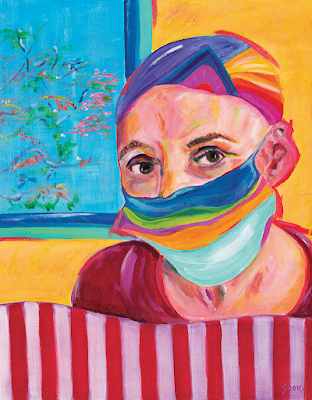
The paintings came from a landscape of dreams, pattern on pattern, impossible colors leaning into one another. She painted her granddaughter striding through a field of her own imagination, she painted herself wearing a mask, she painted me walking down our street with such vividness that I realized I had never seen the street before. I would bring her stacks of art books from the closed bookstore and she all but ate them. Sooki didn’t talk about her husband or her children or her friends or her employer; she talked about color. We talked about art. She brought her paintings upstairs to show us: a person who was too shy to say good night most nights was happy for us to see her work. There was no hesitation on the canvases, no timidity. She had transferred her life into brushwork, impossible colors overlapping, the composition precariously and perfectly balanced. The paintings were bold, confident, at ease. When she gave us the painting she had done of Sparky on the back of the couch, I felt as if Matisse had painted our dog."

“Death,” I said. I didn’t say, Your death. I didn’t say, This thing you live with every minute, this heaving horse’s skull, I held it for you today so that you could talk it out with the people who love you. I had set my intention going in: I wanted to help my friend. In making the journey to Oz, she had found the strength and clarity she needed to go home again." 

"As it turned out, Sooki and I needed the same thing: to find someone who could see us as our best and most complete selves. Astonishing to come across such a friendship at this point in life. At any point in life."

Update 💔:

April 11, 2021

The good thing about passion is that it pushes us forward and keeps us committed and young.


The Soul of a Woman: On Impatient Love, Long Life, and Good Witches
By Isabel Allende

Could talk endlessly about passions.

"We have talked about sexual passion and romantic passion. But what does it mean simply to be passionate? According to the dictionary, it's a disorderly mood disturbance; it is also described as a powerful and irresistible emotion that can lead to obsessive or dangerous actions.
My own definition is less somber. Passion is unbridled enthusiasm, exuberant energy, and determined devotion to someone or something. The good thing about passion is that it pushes us forward and keeps us committed and young. I have been training for years to be a passionate old woman, just as others train to climb mountains or play chess. I don't want to allow caution, so often prevalent in later years, to destroy my passion for life.
Almost all the female protagonists of my books are passionate because they are the people who interest me. I want characters capable of committing obsessive and dangerous actions, as the dictionary says. A safe and quiet life is not good material for fiction. 
I have sometimes been described as a passionate person because I never sat quietly in my house, as was expected of me. I have to clarify that my risky endeavors were motivated not always by a passionate temperament but because circumstances threw me in unexpected directions. I did the best I could. I have lived in a rough sea where waves would lift me and then drop me to the bottom. This surge has been so strong that before, when things went well, I would prepare for a violent fall, which I considered inevitable, instead of relaxing in the tranquility of the moment. Now it's not like that. Now I drift along day after day, happy to just float for as long as possible." 
(pp. 65-6)

"Carmen was my mentor and my friend. She used to say that we were not friends; I was her client and she was my agent, that we only had a business relationship, but that was not true at all. (Nor was her proclamation that she would have liked to be a kept woman. I can't imagine anybody less gifted for that role than she.) Carmen was at my side during my most significant moments, from Paula's illness to family weddings to my divorces, always supporting me unconditionally, always present. 
This woman, who was able to confront the biggest bully, consulted an astrologer; she believed in psychics, gurus, and magic. She would easily get emotional and cry. She cried so much that Gabriel Garcia Marquez dedicated one of his books to her: To Carmen Balcells, bathed in tears
She was generous to an extreme. For my mother's eightieth birthday, she sent eighty white roses all the way to Chile, and when Uncle Ramon turned ninety-nine she did the same for him. She never forgot his birthday because they were born the same day in August. Once she gave me a complete set of Louis Vuitton luggage because she considered mine cheap and old. It was stolen at the airport in Caracas the first and only time I used it, but I didn't tell her because she would have replaced it immediately. She would send me so many chocolates that I still find some hidden in the most unexpected corners of my house.
After the sudden death of this formidable Catalan lady, I had the feeling for a while that I had lost the life vest that kept me afloat in the stormy literary sea. But the agency she created with her talent and vision continues smoothly under the management of her son, Louis Miguel Palomares.
I have Carmen's photograph on my desk to remind me of her advice: Anybody can write a good first book, but a writer is proved by the second and by those that follow; you are going to be judged harshly because success in women is not easily forgiven; write what you want; don't allow anybody to interfere with your work or in the handling of your money; treat your children like royalty, they deserve it; get married, because a husband, no matter if he is a moron, looks good...
After I had published twenty books, which have been translated into forty-something languages, a Chilean writer whose name I don't remember said that I was not a writer, I was a typist. Carmen Balcells asked him if he had formed his opinion based on having read any of my work. His reply: "Over my dead body." This was when I was nominated for the National Prize for Literature. 
In 2010, with the support of four former presidents, several political parties, and Congress, I received the award. Only then did I finally win some respect from Chilean critics. Carmen sent me ten pounds of orange peels covered in dark chocolate, my favorite." 
(pp. 72-4)

February 28, 2021

They had already made each other's acquaintance in the delirium of their noon dreams.


Sula
By Toni Morrison

My first Toni Morrison. I can't wait to dive into more of her works. One wild ride, this Sula

"Which was only fitting, for it was in dreams that the two girls had first met. Long before Edna Finch's Mellow House opened, even before they marched through the chocolate halls of Garfield Primary School out onto the playground and stood facing each other through the ropes of the one vacant swing ("Go on." "No. You go."), they had already made each other's acquaintance in the delirium of their noon dreams. They were solitary little girls whose loneliness was so profound it intoxicated them and sent them stumbling into Technicolored visions that always included a presence, a someone, who, quite like the dreamer, shared the delight of the dream. When Nel, an only child, sat on the steps of her back porch surrounded by the high silence of her mother's incredibly orderly house, feeling the neatness pointing at her back, she studied the poplars and fell easily into a picture of herself lying on a flowered bed, tangled in her own hair, waiting for some fiery prince. He approached but never quite arrived. But always, watching the dream along with her, were some smiling sympathetic eyes. Someone as interested as she herself in the flow of her imagined hair, the thickness of the mattress of flowers, the voile sleeves that closed below her elbows in gold-threaded cuffs. 
Similarly, Sula, also an only child, but wedged into a household of throbbing disorder constantly awry with things, people, voices and the slamming of doors, spent hours in the attic behind a roll of linoleum galloping through her own mind on a gray-and-white horse tasting sugar and smelling roses in full view of a someone who shared both the taste and the speed. 
So when they met, first in those chocolate halls and next through the ropes of the swing, they felt the ease and comfort of old friends. Because each had discovered years before that they were neither white nor male, and that all freedom and triumph was forbidden to them, they had set about creating something else to be. Their meeting was fortunate, for it let them use each other to grow on. Daughters of distant mothers and incomprehensible fathers (Sula's because he was dead; Nel's because he wasn't), they found in each other's eyes the intimacy they were looking for."
(p. 52)

July 30, 2019

That's when I knew she was forever caught in her own undercurrent, bouncing from one deep swell to the next.

© Gustavo Rimada
Sabrina & Corina
Kali Fajardo-Anstine

I added this collection of short stories to my reading list after I came across this Instagram post by Latinas Poderosas, highlighting Kali's following quote: "I think our ancestors were shamed for speaking Spanish, and now I feel shame for not speaking Spanish." I felt that deeply, and my shame & frustration of not being able to speak my language fluently—despite it being my first, native language—is constant. It's hard because it feels natural to blame myself, or my parents, and each produces guilt or a feeling of inferiority, or both. It's not anyone's fault. Instead, I'm trying to face that I've internalized shame over the years, passed down from generations. Lately, I've been trying to enter more spaces that are celebratory of my Latinx heritage, and to fully embrace it shamelessly, even if I don't always feel like I "belong." A few years ago, I enrolled in an intermediate Spanish conversation class and quickly noticed a difference, so I may do that again soon.

A powerful meditation on friendship, mothers and daughters, and the deep-rooted truths of our homelands...Sabrina & Corina is a moving narrative of unrelenting feminine power and an exploration of the universal experiences of abandonment, heritage, and an eternal sense of home

The storytelling here was moving; the writing surprising and great—infused with magic and hard truths. The stories represent powerful resistance to negative patterns and the yearning to represent and be more than your past. Appreciative for how a thing can find its way to you when you need it.

"I thought of all the women my family had lost, the horrible things they'd witnessed, the acts they simply endured. Sabrina had become another face in a line of tragedies that stretched back generations. And soon, when the mood hit my grandmother just right, she'd sit at her kitchen table, a Styrofoam cup of lemonade in her warped hand, and she'd tell the story of Sabrina Cordova—how men loved her too much, how little she loved herself, how in the end it killed her. The stories always ended the same, only different girls died, and I didn't want to hear them anymore."
(from title story, "Sabrina and Cordova," p. 44)

"Her stance was wobbly and unrefined, as though she had given someone else permission to wear her skin. That's when I knew she was forever caught in her own undercurrent, bouncing from one deep swell to the next. She would never lift me out of that sea. She would never pause to fill her lungs with air. Soon the world would yank her chain of sadness against every shore, every rock, every glass-filled beach, leaving nothing but the broken hull of a drowned woman. I turned away from my mother then, heading toward the carriage house, whispering no so many times that I sounded like a cooing dove. My mother asked for more than once for me to stop. The further I walked, the further her voice moved from giddy to shrill, rising above the hibiscus and palm trees, booming off the front house and carriage house doors."
("Any Further West," p. 179)


December 18, 2017

The ability to forgive oneself. Stop here for a few breaths and think about this because it is the key to making art.


© HarperCollins

This Is the Story of a Happy Marriage
By Ann Patchett

I have Reese Witherspoon and Hello Sunshine to thank for borrowing this selection of essays. (Hi, Reese is my new idol; love her unapologetic ambition. Thinkin' of my ambition and all of my plans for 2018 & beyond. Fills me with excitement. Love that I don't have to feel sorry about it.)

"Living a life is not the same as writing a book, and it got me thinking about the relationship between what we know and what we can put on paper. For me it's like this: I make up a novel in my head (there will be more about this later). This is the happiest time in the arc of my writing process. The book is my invisible friend, omnipresent, evolving, thrilling. During the months (or years) it takes me to put my ideas together, I don't take notes or make outlines; I'm figuring things out, and all the while the book makes a breeze around my head like an oversized butterfly whose wings were cut from the rose window in Notre Dame.
This book I have not yet written one word of is a thing of indescribable beauty, unpredictable in its patterns, piercing in its color, so wild and loyal in its nature that my love for this book, and my faith in it as I track its lazy flight, is the single perfect joy in my life. It is the greatest novel in the history of literature, and I have thought it up, and all I have to do is put it down on paper and then everyone can see this beauty that I see."
("The Getaway Car," pp. 24-5)

"The art of writing comes way down the line, as does the art of interpreting Bach. Art stands on the shoulders of craft, which means that to get to the art you must master the craft. If you want to write, practice writing. Practice it for hours a day, not to come up with a story you can publish, but because you long to learn how to write well, because there is something that you alone can say. Write the story, learn from it, put it away, write another story. Think of a sink pipe filled with sticky sediment. The only way to get clean water is to force a small ocean through the tap. Most of us are full up with bad stories, boring stories, self-indulgent stories, searing works of unendurable melodrama. We must get all of them out of our system in order to find the good stories that may or may not exist in the freshwater underneath."
("The Getaway Car," pp. 29)

"Forgiveness. The ability to forgive oneself. Stop here for a few breaths and think about this because it is the key to making art, and very possibly the key to finding any semblance of happiness in life."
("The Getaway Car," pp. 29)

"Enough time has passed that I wish him well, in a way that is so distant and abstract it doesn't even matter."
("The Sacrament of Divorce," p. 61)

"Sifting through the notes I had taken years before, I remembered the basic point behind my intentions, and all these years later that point has never changed: I am proud of my father. I am proud of his life's work. For a brief time, I saw how difficult it would be to be a police officer in the city of Los Angeles, how easy it would be to fail at the job, as so many have failed. My father succeeded. He served his city well. I wanted to make note of that."
("The Wall," p. 153)

"The ability to have a friend, and be a friend, is not unlike the ability to learn. Both are rooted in being accepting and open-minded with a talent for hard work. If you are willing to stretch yourself, to risk yourself, if you are willing to love and honor and cherish the people who are important to you until one of you dies, then there will be great heartaches and even greater rewards."
("The Right to Read," p. 193)

"I believe it is human nature to try to persuade others that our most passionately held beliefs are true, so that they too can know the joy of our deepest convictions."
("Introduction to The Best American Short Stories 2006," p. 208)

"Standing waist deep in the swimming pool at Yaddo, I received a gift—it was the first decent piece of instruction about marriage I had ever been given in my twenty-five years of life. "Does your husband make you a better person?" Edra asked.
There I was in that sky-blue pool beneath a bright blue sky, my fingers breaking apart the light on the water, and I had no idea what she was talking about.
"Are you smarter, kinder, more generous, more compassionate, a better writer?" she said, running down her list. Does he make you better?"
"That's not the question," I said. "It's so much more complicated than that."
"It's not more complicated than that," she said. "That's all there is: Does he make you better and do you make him better?"
("This Is the Story of a Happy Marriage," p. 249)

"My mother shrugged, so what. "I'll die, you'll die, he'll die, you'll get tired of each other. You don't always know how it's going to happen but it's always going to happen. So stop trying to make everything permanent. It doesn't work. I want you to go out there and find some nice man you have no intention of spending the rest of your life with. You can be very, very happy with people you aren't going to marry."
("This Is the Story of a Happy Marriage," p. 252)

"There were two things about marriage that surprised me. The first was that I discovered Karl had been holding out on me. He actually loved me more than he had previously led me to believe. This is not to say he hadn't loved me for the past eleven years, he had, but there was a portion of himself he kept to himself, thinking that if I wouldn't marry him, then chances were at some point I would go. It was like finding another wing in a house you had happily lived in for years. It was simply a bigger love than I had imagined."
("This Is the Story of a Happy Marriage," p. 265)

May 17, 2015

In the end, we were more alike than not, and gravitated toward each other, however wide the breach.

Just Kids
By Patti Smith

Just Kids is the most beautiful tribute to someone I've ever read. I finished it this morning, and have been thinking about it all day. I listened to Horses for the first time while I made dinner. Just me and my thoughts and the music. It felt appropriate and I loved it in a way I don't think I could have before. I'm sad, but in complete awe. So incredible are the connections human beings can create with one another if they want to, if they're open, if it's meant to be. What a gift that Patti could capture hers with Robert this way to share with others.

"We used to laugh at our small selves, saying that I was a bad girl trying to be good and that he was a good boy trying to be bad. Through the years these roles would reverse, then reverse again, until we came to accept our dual natures. We contained opposing principles, light and dark."
(p. 9)

"Our social differences, however exasperating, were tinged with love and humor. In the end, we were more alike than not, and gravitated toward each other, however wide the breach. We weathered all things, large and small, with the same vigor. To me, Robert and I were irrevocably entwined, like Paul and Elisabeth, the sister and brother in Cocteau's Les Enfants Terribles. We played similar games, declared the most obscure object treasure, and often puzzled friends and acquaintances by our indefinable devotion.
He had been chided for denying his homosexuality; we were accused of not being a real couple. In being open about his homosexuality, he feared our relationship would be destroyed.
We needed time to figure out what all of this meant, how we were going to come to terms and redefine what our love was called. I learned from him that often contradiction is the clearest way to truth."
(p. 200)

On Robert shooting the album cover for Horses:

"The light was already fading. He had no assistant. We never talked about what we would do, or what it would look like. He would shoot it. I would be shot.
I had my look in mind. He had his light in mind. That is all.
Sam's apartment was spartan, all white and nearly empty, with a tall avocado tree by the window overlooking Fifth Avenue. There was a massive prism that refracted the light, breaking it into rainbows cascading on the wall across from a white radiator. Robert placed me by the triangle. His hands trembled slightly as he readied to shoot. I stood.
The clouds kept moving back and forth. Something happened with his light meter and he became slightly agitated. He took a few shots. He abandoned the light meter. A cloud went by and the triangle disappeared. He said, "You know, I really like the whiteness of the shirt. Can you take the jacket off?"
I flung my jacket over my shoulder, Frank Sinatra style. I was full of references. He was full of light and shadow.
"It's back," he said.
He took a few more shots.
"I got it."
"How do you know?"
"I just know."
He took twelve pictures that day.
Within a few days he showed me the contact sheet. "This one has the magic," he said.
When I look at it now, I never see me. I see us."
(pp. 250-251)