I have spent the much of my life contemplating the experience of feeling unseen by most and understood by few.
My heart swelled reading this, enthralled by each sentence the whole way through, wondering how it would end. It turned my whole evening around and instilled confidence and a resurfacing desire to be connected.
It inspired and reminded me to be open.
It is a reminder I can live a full life, complete with unconditional love and supportive friendship. That I can receive openness; that I can, am worthy, and should give it too.
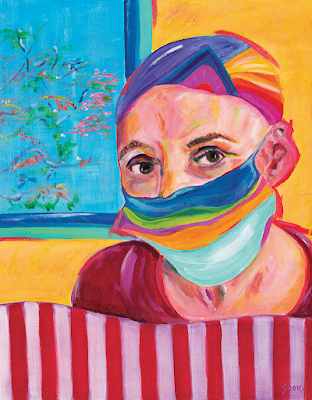
"Renée Fleming spent two years in Germany studying voice while she was in her twenties. She told me that over the course of her life, each time she went back to Germany she found her fluency had mysteriously improved, as if the language had continued to work its way into her brain regardless of whether she was speaking it. This was the closest I could come to understanding what happened to Sooki. After her first round of cancer, while she recovered from the Whipple and endured the FOLFIRINOX, she started to paint like someone who had never stopped. Her true work, which had lingered for so many years in her imagination, emerged fully formed, because even if she hadn’t been painting, she saw the world as a painter, not in terms of language and story but of color and shape. She painted as fast as she could get her canvases prepped, berating herself for falling asleep in the afternoons. “My whole life I’ve wanted this time. I can’t sleep through it.”
The paintings came from a landscape of dreams, pattern on pattern, impossible colors leaning into one another. She painted her granddaughter striding through a field of her own imagination, she painted herself wearing a mask, she painted me walking down our street with such vividness that I realized I had never seen the street before. I would bring her stacks of art books from the closed bookstore and she all but ate them. Sooki didn’t talk about her husband or her children or her friends or her employer; she talked about color. We talked about art. She brought her paintings upstairs to show us: a person who was too shy to say good night most nights was happy for us to see her work. There was no hesitation on the canvases, no timidity. She had transferred her life into brushwork, impossible colors overlapping, the composition precariously and perfectly balanced. The paintings were bold, confident, at ease. When she gave us the painting she had done of Sparky on the back of the couch, I felt as if Matisse had painted our dog."
“Death,” I said. I didn’t say, Your death. I didn’t say, This thing you live with every minute, this heaving horse’s skull, I held it for you today so that you could talk it out with the people who love you. I had set my intention going in: I wanted to help my friend. In making the journey to Oz, she had found the strength and clarity she needed to go home again."
"As it turned out, Sooki and I needed the same thing: to find someone who could see us as our best and most complete selves. Astonishing to come across such a friendship at this point in life. At any point in life."
The Soul of a Woman: On Impatient Love, Long Life, and Good Witches
By Isabel Allende
"I would like to have Sophia Loren's full breasts and long legs, but if given a choice, I prefer the gifts of several good witches I know: purpose, compassion, and good humor."
(p. 83)
"According to Gerald G. Jampolsky, a famous psychiatrist and the author of many bestsellers about psychology and philosophy, an aptitude for happiness is determined 45 percent by genes and 15 percent by circumstances. That means that the remaining 40 percent is based on our beliefs and attitude about life. Even at ninety-five, Jampolsky is still seeing patients and writings; he goes to the gym five days a week, and every morning when he wakes up he gives thanks for the new day and commits to live it happily, no matter his physical state. Age should not limit our energy or creativity or our willingness to participate in the world.
Now that we live longer, we have a couple of decades ahead of us to redefine our goals and find meaning in the years to come. Jampolsky recommends letting go of grievances and negativity. More energy is needed to sustain ill feelings than to forgive. The key to contentment is forgiveness of others and of ourselves. Our last years can be the best if we opt for love instead of fear, he says. Love doesn't grow old like a wild plant, it needs a lot of care."
(pp. 85-6)
"This has strengthened my decision to be active forever and use every brain cell and soul spark so there will be nothing left when I go."
(p. 87)
"For as long as possible I will crawl up the stairs to the attic where I write and spend my days entertained by telling stories. If I can achieve that, old age is none of my business."
(p. 88)
"In brief, I am in a splendid moment of my destiny. This is good news for women in general: Life gets easier once we get through menopause and are done with raising kids, but only if we minimize our expectations, give up resentment, and relax in the knowledge that no one, except those closest to us, gives a damn about who we are or what we do. Stop pretending, faking it, lamenting, and flagellating ourselves about silly stuff. We have to love ourselves a lot and love others without calculating how much we are loved in return. This is the stage of kindness."
The Soul of a Woman: On Impatient Love, Long Life, and Good Witches
By Isabel Allende
Could talk endlessly about passions.
"We have talked about sexual passion and romantic passion. But what does it mean simply to be passionate? According to the dictionary, it's a disorderly mood disturbance; it is also described as a powerful and irresistible emotion that can lead to obsessive or dangerous actions.
My own definition is less somber. Passion is unbridled enthusiasm, exuberant energy, and determined devotion to someone or something. The good thing about passion is that it pushes us forward and keeps us committed and young. I have been training for years to be a passionate old woman, just as others train to climb mountains or play chess. I don't want to allow caution, so often prevalent in later years, to destroy my passion for life.
Almost all the female protagonists of my books are passionate because they are the people who interest me. I want characters capable of committing obsessive and dangerous actions, as the dictionary says. A safe and quiet life is not good material for fiction.
I have sometimes been described as a passionate person because I never sat quietly in my house, as was expected of me. I have to clarify that my risky endeavors were motivated not always by a passionate temperament but because circumstances threw me in unexpected directions. I did the best I could. I have lived in a rough sea where waves would lift me and then drop me to the bottom. This surge has been so strong that before, when things went well, I would prepare for a violent fall, which I considered inevitable, instead of relaxing in the tranquility of the moment. Now it's not like that. Now I drift along day after day, happy to just float for as long as possible."
(pp. 65-6)
"Carmen was my mentor and my friend. She used to say that we were not friends; I was her client and she was my agent, that we only had a business relationship, but that was not true at all. (Nor was her proclamation that she would have liked to be a kept woman. I can't imagine anybody less gifted for that role than she.) Carmen was at my side during my most significant moments, from Paula's illness to family weddings to my divorces, always supporting me unconditionally, always present.
This woman, who was able to confront the biggest bully, consulted an astrologer; she believed in psychics, gurus, and magic. She would easily get emotional and cry. She cried so much that Gabriel Garcia Marquez dedicated one of his books to her: To Carmen Balcells, bathed in tears.
She was generous to an extreme. For my mother's eightieth birthday, she sent eighty white roses all the way to Chile, and when Uncle Ramon turned ninety-nine she did the same for him. She never forgot his birthday because they were born the same day in August. Once she gave me a complete set of Louis Vuitton luggage because she considered mine cheap and old. It was stolen at the airport in Caracas the first and only time I used it, but I didn't tell her because she would have replaced it immediately. She would send me so many chocolates that I still find some hidden in the most unexpected corners of my house.
After the sudden death of this formidable Catalan lady, I had the feeling for a while that I had lost the life vest that kept me afloat in the stormy literary sea. But the agency she created with her talent and vision continues smoothly under the management of her son, Louis Miguel Palomares.
I have Carmen's photograph on my desk to remind me of her advice: Anybody can write a good first book, but a writer is proved by the second and by those that follow; you are going to be judged harshly because success in women is not easily forgiven; write what you want; don't allow anybody to interfere with your work or in the handling of your money; treat your children like royalty, they deserve it; get married, because a husband, no matter if he is a moron, looks good...
After I had published twenty books, which have been translated into forty-something languages, a Chilean writer whose name I don't remember said that I was not a writer, I was a typist. Carmen Balcells asked him if he had formed his opinion based on having read any of my work. His reply: "Over my dead body." This was when I was nominated for the National Prize for Literature.
In 2010, with the support of four former presidents, several political parties, and Congress, I received the award. Only then did I finally win some respect from Chilean critics. Carmen sent me ten pounds of orange peels covered in dark chocolate, my favorite."
The Soul of a Woman: On Impatient Love, Long Life, and Good Witches
By Isabel Allende
Fondly remembering when my best friend and I started an all girls magazine in fifth grade (It's A Girl's World) and convinced some of our classmates to subscribe for a very minimal fee. I don't think we "published" it for very long, but I'm giving high fives & pats on the back to our former selves for being brave, cute, and feminist, before we even knew what that meant.
"Everything changed for me in 1967 when I started working as a journalist at Paula, a newly launched feminist magazine. (The name has nothing to do with my daughter's; it was one of those names that suddenly became popular and omnipresent.) The editor was Delia Vergara, a young and beautiful journalist who had lived in Europe and had a clear vision of the type of magazine she wanted. With that in mind, she gathered her small team. The magazine saved me from being suffocated by frustration.
We were four young women in our twenties ready to shake up Chilean prudery. In our country, which was very conservative and had a provincial mentality, social mores had not changed much over the last century. We got inspiration from magazines and books from Europe and North America. We read Sylvia Plath and Betty Friedan, and later Germaine Greer, Kate Miller, and other writers who helped us define ideas and express them eloquently.
I opted for humor because I soon realized that the most daring ideas can be accepted if they elicit a smile. That's how my column "Civilize Your Troglodyte" came to be. It made fun of machismo, and ironically became very popular among men. "I have a friend who is just like your troglodyte," they would say to me. (Always a friend.) Some female readers, on the other hand, felt threatened because the column shook the very foundation of their domestic world.
I was comfortable in my skin for the first time. I wasn't a lonely lunatic; millions of women shared my concerns. There was a women's liberation movement happening on the other side of the Andes Mountains and our magazine intended to spread it throughout Chile.
From those foreign intellectuals whose books we read, I learned that anger without purpose is useless and even harmful; I had to act if I wanted change...
My three colleagues and I wrote with a knife between our teeth; we were a scary gang. What did we want to change? Nothing short of the whole world. With the arrogance of youth, we thought that could be done in ten or fifteen years. This was more than half a century ago and look where we still are today. But I have not lost faith that it can be achieved, and my accomplices from that time, who are as old as I, haven't either. And yes, I use the word old, which seems to be pejorative. I do so on purpose because I am proud of my age. Every year I have lived and every wrinkle I have tell my story."
Good timing: Alicia's memoir was actually nearing its one year anniversary while I listened to it. On Instagram, she read a passage from the book about her shift from a scarcity to abundance mindset. I'm still learning how myself.
"Money, like all life, is an energy exchange. You give yourself over to whatever you're passion about and what comes back to you is energy in the form of monetary compensation. You attract more or less of what you want by how you choose to interact with it, as well as what you believe about yourself. Do you truly feel you deserve what you're asking for? Are you worth it? How you answer impacts what comes your way. What you focus on expands. If you focus on the goodness in your life, you create more of it and if you live with an open palm, rather than a closed fist, you leave room for immeasurable blessings to flow through your hands. It was one of the strongest lessons ever passed on to me in the classroom my life was becoming."
Alicia Keys' music is a staple of my early years. But I don't think I became fully conscious to her spirit until recently. I remember viewing the Red Table (Piano) Talk episode with Alicia and feeling so completely seen and empowered as she described herself as a recovering peacemaker and people pleaser who'd awakened to her needs and her power, learning to give herself tenderness along the way. Listening to her read these passages from her memoir stirred something in me.
"Oprah sat quietly for a moment before answering. 'For many years,' she said, 'I looked for someone outside of myself to dream up and create what only I could. I eventually realized that no one else could see your big picture. Only you know the journey you're on. Others can contribute, and you should definitely surround yourself with smart people who lift you higher and share in your vision, but the truth is, even with wise counsel only you know what your next step should be.'
All of my best decisions in life have come when I tuned into what felt like the best moves for me. I'd spent much of my life looking at others for answers, allowing their opinions to drown out my instincts. My default was to substitute others' desires for my own. In fact, I'd done that so much that it became a habit, one I'm still unlearning. I've needed a lot of practice at putting my own ideas and intuition at the forefront and Oprah was encouraging me to, again, rehearse. As I sat there across from her, taking in her wisdom, I realized where my anxiety was coming from. I was expecting someone else to fill a space that only I could stand in. I've read a lot about what it means to listen to your inner voice, that whisper in your gut that is always speaking.
On paper, I understood the idea, but in reality I was clearly still struggling. That afternoon Oprah articulated the lesson to me in a way that turned on the lights. 'You know what a resounding yes feels like,' she said. 'It's undeniable. Nothing's going to stop you from doing it, you're excited, you don't have to convince yourself to move forward. You simply know this is the right thing and that is what I live by.'
I've made a lot of decisions from my head, I've chosen to go in this direction or that one based on finances, or because something seems like a great opportunity, or because I don't want to hurt people's feelings or disappoint them, or because someone is pushing me towards an agenda that serves them. But when I've listened to my heart, when I've trusted what my spirit is telling me, that yes has always steered me right."
"Rather than basking in the glow of those miracles, I shrank. At certain moments, I even dumbed myself down or chose not to talk about the many blessings I received. I figured that if I shared my experience in its entirety, if I took the lid off my joy, it would push others away or make them feel small. As my career progressed, that tendency took another form in my interactions around the industry. 'I don't need much, nothing has to be too grand, I'm cool with my little piano, my bench and a cup of water.' In a sense, that was true. I'd never been an over-the-top kind of girl, but what's also true is this: some part of my spirit was always signing up for less because that is what I believed I deserved. For so many years I thought I was just being modest. I never wanted to come across as self-absorbed or as someone with a big head. It's how we women are brought up: don't ask for more, don't take credit, don't outshine others.
But there on the couch it hit me that my alleged modesty was just a disguise, a mask for a lack of self worth. It was a huge revelation. For me, that seed of worthlessness was planted in childhood. As well-intentioned as Craig was, and as much as he was dealing with in his own life, his absence impacted me in ways I'm still uncovering. It left a hole in me. When a child's parent is not there, even if the reasons are completely legitimate, that child interprets the absence exactly as I did. 'I don't matter enough for you to show up for me. I'm not important.' And in those early years, when I was forming my identity, I took on a belief parallel to that interpretation. 'If you don't value me, I must not be valuable.' A big part of my journey has been about changing that view, as well as getting clear on the other beliefs passed on to me by my parents.
"There are only two people you ever have to deal with," a life coach recently told me. "Your mother and father." As I deal with the man who gave me life, and as we work to create a new story, what I've discovered is this: neither Craig nor my beloved mom is responsible for where I go from here. I am. The price of admission for self-ownership is total responsibility and I can move forward only if I'm willing to ask myself the hard questions and examine my beliefs.
In life, we don't get what we ask for, we get what we believe. And what we believe about ourselves shows up in our energy. It's how we walk into a room, it's how we communicate through body language. 'I don't deserve to be here.' It's whether we sit up straight or hide out in the back of a meeting. At times, my own energy has been saying 'I'm cool with the bare minimum, don't give me more.' Without knowing it, I stunted my growth because I was scared to be magnificent and doubtful that I was. If you asked me at age 22 whether I thought I was worthy, I would've answered loud and proud "YES!" But it's possible to declare a woman's worth and yet not fully know your own. It's possible to say you want a grand life but then continue to play small. In many ways, I have played big. I've embraced experiences I never dreamed I'd have and I've risen to some enormous moments, but there's still more I can do, other ways for me to grow.
And as I keep relearning, it's okay to own a desire for more. In fact, it's how we honor those who have paved the way for our place at the table. 'You don't want modesty,' Maya Angelou once said. 'You want humility. Humility comes from inside out. It says someone was here before me, and I'm here because I've been paid for. I have something to do and I will do that because I'm paying for someone else who has yet to come.' When we dim our light, we don't do anyone a favor. It's a disservice because when you're in the presence of someone who knows his or her worth, like the extraordinary Maya did, you want to shine brighter. Self-honoring energy is contagious.
At the start of my career I thought I was such a novice, but at 19 I knew the one thing that is most important to know. I understood who I was at my center, I was closer to my truth than I'd become during my twenties. It's not that I wasn't authentic to some degree at every stage, it's just that out of a desire to please others or to squeeze into a mold, I made the outside world my point of reference. 'Will they like me if I dress or speak or walk or talk this way?' Finally, in my early 30s I stepped into my girl on fire energy. I moved back towards my essence."
Aforementioned Red Piano Talk. Alicia performs "Girl on Fire" at the end.
Also all of this, starting with a performance of "Show Me Love."
Full circle revelations and a mind expanded. These only scratch the surface of all I highlighted!
"Self-love is the foundation of our loving practice. Without it our other efforts to love fail."
(p. 67)
"There is no better place to learn the art of loving than in community."
(p. 129)
"When we see love as the will to nurture one's own or another's spiritual growth, revealed through acts of care, respect, knowing, and assuming responsibility, the foundation of all love in our life is the same."
(p. 136)
"Generous sharing of all resources is one concrete way to express love. These resources can be time, attention, material objects, skills, money etc...Once we embark on love's path we see how easy it is to give. A useful gift all love's practitioners can give is the offering of forgiveness. It not only allows us to move away from blame, from seeing others as the cause of our sustained lovelessness, but it enables us to experience agency, to know we can be responsible for giving and finding love. We need not blame others for feelings of lack, for we know how to attend to them. We know how to give ourselves love and to recognize the love that is all around us. Much of the anger and rage we feel about emotional lack is released when we forgive ourselves and others. Forgiveness opens us up and prepares us to receive love. It prepares the way for us to give wholeheartedly."
(p. 163)
"When one knows a true love, the transformative force of that love lasts even when we no longer have the company of the person with whom we experienced profound mutual care and growth. Thomas Merton writes: "We discover our true selves in love." Many of us are not ready to accept and embrace our true selves, particularly when living with integrity alienates us from our familiar worlds. Often, when we undergo a process of self-recovery, for a time we may find ourselves more alone. Writing about choosing solitude over company that does not nurture one's soul, Maya Angelou reminds us that "it is never lonesome in Babylon." Fear of facing true love may actually lead some individuals to remain in situations of lack and unfulfillment. There they are not alone, they are not at risk. To love fully and deeply puts us at risk."
(p. 187)
"Understanding that death is always with us can serve as the faithful reminder that the time to do what we feel called to do is always now and not in some distant and unimagined future."
(p. 203)
"Contrary to what we may have been taught to think, unnecessary and unchosen suffering wounds us but need not scar us for life. It does mark us. What we allow the mark of our suffering to become is in our own hands. In his collection of essays The Fire Next Time, James Baldwin writes about suffering in the healing process, stating: "I do not mean to be sentimental about suffering—but people who cannot suffer can never grow up, can never discover who they are." Growing up is, at heart, the process of learning to take responsibility for whatever happens in your life. To choose growth is to embrace a love that heals."
(pp. 210-1)
"Forgiveness not only enables us to overcome estrangement, it intensifies our capacity for affirming one another. Without conscious forgiveness there can be no genuine reconciliation. Making amends both to ourselves and to others is the gift compassion and forgiveness offers us. It is a process of emptying out wherein we let go all the waste so that there is a clear place within where we can see the other as ourselves."