My Broken Language: A Theater Jawn (A play based on the memoir)
By Quiara Alegría Hudes
I loved everything about this lyrical coming-of-age tribute to childhood, memory, and the women Quiara grew up with and loved. I zipped through this in a day a few weeks ago. But in the spring of 2024, I saw Quiara and a cast read an excerpt at The Center for Fiction. And afterwards, instead of doing a traditional Q&A as planned, she changed her mind and led a manifestation healing ceremony with her bruja plant, descendant of the one from her grandfather's farm in Puerto Rico. Anyone who wanted to participate got in line and pulled a leaf from the perennial succulent themselves. Though the plant is known to be resilient mine, never grew into something more (though it tried for weeks!)—and I still think about that 'failure' a lot. What it means.
Anyway. Loved it. Loved the recommended song choices (including one below) that enhanced my reading. Short, fierce, soulful, devastating, true.
"In her hands were 10,000 yesterdays." - From Abuela's rice recipe
(p. 33)
"Those books were definitive experiences. Their impact on me felt unquantifiable yet real as Abuela's palm cupping dry rice. They were recipes for my life's inner feast."
I've wondered if I'd ever write here again and it doesn't make any sense to—I'd imagined by this point I would've translated this effort to another, more modern medium as Blogspot becomes more and more irrelevant.
Now that I am in a months-long spree of clearing out my apartment and donating many of my books (only deciding to keep what I love or is useful longterm), I'm returning to the marked pages and words I meant to note before I make my donation to the neighborhood free library stand.
Sonora made me quite sad, actually. And while by this point I don't really remember much of it, I do remember that. Still, there were a few descriptors that stood out.
"Laura turned to me. She had amber eyes. They alighted from her deeply tanned face like a beautiful curse. Her hair was streaked magenta. "I'm Laura," she said. She pronounced it the Spanish way, though no one else ever did. We sat there quietly observing the others. Laura hummed a tune dreamily as if I weren't there at all."
(p. 11)
"Like faces, the smell of a person cannot be replicated. The smell of a fire in my hair from a particular party, the smell of a friend's perfume rubbed into my shirt. The smell of lipstick and chalk soaking the dressing rooms at dance rehearsals. The smell of a lover in your fingernails the morning after. The smell of my mother: orange peel, suntan lotion, faint vanilla. The smell of Laura: lavender laundry detergent, danger, linger of red wine, sweat, cigarette. The smell of Eli: the smell of seventeen, of the beach at night, coconut, white blossom, salt, stars. The smell of Dylan: vodka, fire, dirt in autumn, February in the desert. The smell of my father: Ralph Lauren Safari, cumin, tobacco, spearmint, musk, red meat. Home."
(p. 64)
"I felt happiest in my exchanges at bodegas over the purchase of a coffee or cigarettes or when observing the break-dancers twirl and the mariachis croon. All intimacy was exchanged as if in a foreign language, via gestures and quick, mistaken glances on the train." (p. 102)
I've spent the first weeks of the new year loving on myself, nurturing all parts, including the parts I find hard to accept and/or want to change (think less rose woman, more thorn). Repeating "I forgive myself" over and over for what's found in the abyss.
My 2023 reflections are a jumble of words and phrases building in a note, waiting to be organized into coherent sentences, and in an ideal world I'd share them soon.
I spent the holidays in Houston immersed in lots of quiet, in familiar love and also in the discomfort of feeling out of place in a space that's been my go-to for 10 years. Reclaiming objects and mementos that are mine for safekeeping, and leaving behind something intangible. Thinking about what happens when home shifts. When I shift. How I've grown immensely and how sometimes that means widening a gap. Feeling some guilt and sadness.
Going through old photos, I experienced pangs, but what was hurting me? The love lost that existed in the taking of the photographs? The little girl in the photos, so spunky and radiant (who I am trying to get back to)? Saying goodbye to a "home"? Probably all of the above. And yesterday I remembered I went through this exercise nearly 10 years ago when I was moving out on my own for the first time. But now I have a decade's worth of layered memories and losses to compound the ache.
I read "Crying in H Mart" in the fall. She was so honest and flawed and brave. I knew Michelle Zauner as Japanese Breakfast first, and I played "Paprika" during my 33rd birthday photoshoot to feel more dreamy. I saw her perform at Radio City on October 4, where she announced she would be moving to Korea for 2024. I love that her journey has culminated to her current reality, despite a devastating loss. I'm so stoked for her year and the subsequent second book.
---
She was my champion, she was my archive. She had taken the utmost care to preserve the evidence of my existence and growth, capturing me in images, saving all my documents and possessions. She had all knowledge of my being memorized. The time I was born, my unborn cravings, the first book I read. The formation of every characteristic. Every ailment and little victory. She observed me with unparalleled interest, inexhaustible devotion.
Now that she was gone, there was no one left to ask about these things. The knowledge left unrecorded died with her. What remained were documents and my memories, and now it was up to me to make sense of myself, aided by the signs she left behind. How cyclical and bittersweet for a child to retrace the image of their mother. For a subject to turn back to document their archivist.
I had thought fermentation was controlled death. Left alone, a head of cabbage molds and decomposes. It becomes rotten, inedible. But when brined and stored, the course of its decay is altered. Sugars are broken down to produce lactic acid, which protects it from spoiling. Carbon dioxide is released and the brine acidifies. It ages. Its color and texture transmute. Its flavor becomes tarter, more pungent. It exists in time and transforms. So it is not quite controlled death, because it enjoys a new life altogether.
The memories I had stored, I could not let fester. Could not let trauma infiltrate and spread, to spoil and render them useless. They were moments to be tended. The culture we shared was active, effervescent in my gut and in my genes, and I had to seize it, foster it so it did not die in me. So that I could pass it on someday. The lessons she imparted, the proof of her life lived on in me, in my every move and deed. I was what she left behind. If I could not be with my mother, I would be her.
(pp. 223-4, "Kimchi Fridge")
Lucidity came slowly
I awoke from dreams of untying a great knot
It unraveled like a braid
Into what seemed were
Thousands of separate strands of fishing line
Attached to coarse behavior it flowed
A calm it urged, what else is here?
How's it feel to be at the center of magic
To linger in tones and words?
I opened the floodgates
And found no water, no current, no river, no rush
How's it feel to stand at the height of your powers
To captivate every heart?
Projecting your visions to strangers who feel it
Who listen, who linger on every word
Oh, it's a rush
Oh, it's a rush
But alone it feels like dying
All alone I feel so much
I want my offering to woo, to calm, to clear, to solve
But the only offering that comes
It calls, it screams, there's nothing here
How's it feel to be at the center of magic
To linger in tones and words?
I opened the floodgates
And found no water, no current, no river, no rush
How's it feel to stand at the height of your powers
Towards the end of the summer, I found the most delicious, luscious, fragrant pink roses. I have been searching for roses as fragrant since to no avail. In an unexpected turn of events, I discovered the same potent fragrance today...via a Yankee Candle in a Houston, TX mall. It'll do for now.
In searching for photos of the original bouquet, I remembered my friend gave me Antoine de Saint-Exupéry's "Con Un Sogno in Testa" (which I have yet to read but can't wait to) and this excerpt from Hilarie Burton Morgan's "Grimoire Girl," whose magic spells and stories I devoured on a recent trip to the Dominican Republic. In it, she describes cutting roses from her garden and discovering a dying bee in one—admiring the flower like the Little Prince did his rose till its death—while she reflected on passing of her dear friend, life cycles, being your softest self.
Plump and sultry summer August night featuring the Chrysler and the full moon
My Inner Sky: On Embracing Day, Night, and All the Times in Between
By Mari Andrew
Sweet & perfect summer 2023; feverishly nodding 'yes' to Mari's ode to August.
For many creative people, regret and longing is what we live for. We love limitations, especially the wistful ones. August is a three-week foreign love affair that you can't bring back home. August is a beautiful person who just got off the subway, or a tomato whose prime you may miss by a couple of hours. August is a sunset, a Sunday, the last hour of the best party.
It is one of my favorite months. Every year, like clockwork, I begin to see summer's charms when its days are numbered. I get preemptively nostalgic for the nights that feel as plump and sultry as an overripe plum, and I begin to miss the sundresses I haven't even worn yet. It's like living the last days of a relationship you know is about to end, and there's magic in that ache.
Changes in the external world can cause great misery when we do not know how to engage and heal ourselves. Moments of pain and discomfort, or encounters with ideas that may break the mental images we have created of the world, are normally things we not only run away from but also things we build walls to defend ourselves from. These walls we build in our minds and hearts make sense when we don't know any better. We all have the right to protect ourselves from pain, but be aware that these walls can turn from protection into prison—the more walls we build around ourselves, the less space we have to grow and be free. We have a harder time releasing the habits that cause misery when we are surrounded by the psychological walls we have constructed, causing us to stagnate and fall into a rhythm where we are always running within a space that is slowly growing smaller.
(p. 15)
There is an important difference between dwelling in misery and understanding that on the path of healing things will come up that sometimes cause us to feel the old emotions and patterns that we are working on letting go. There is great power in honoring the reality of our current emotions—not feeding them or making them worse but simply recognizing that this is what has arisen in this present moment and that this will also change. When we create this space within ourselves—a space of calmness that is undisturbed by the storm—the storm tends to pass more quickly.
Practicing such profound honesty within ourselves helps in all facets of internal and external life—there is no real freedom without honesty, and without honesty, there can be no peace of mind. Healing ourselves isn't about constantly feeling bliss; being attached to bliss is a bondage of its own. Trying to force ourselves to be happy is counterproductive, because it suppresses the sometimes tough reality of the moment, pushing it back within our depths of our being, instead of allowing it to arise and release.
Time to pull a handful of posts out of the drafts folder...
As desired, I re-read Ghosts earlier this year, in the middle of winter (again). It made me cry (again). It also made me feel tinges of hope and empathy as I further dissected the parallels in Nina George's journey to mine and those of the people I know, as told via Dolly's delicious prose and metaphor.
Ongoing: I continue to contemplate the ghosts of my friendships, romances, and family.
This is one of my favorite moments from the novel. I had never consciously considered the ways loved ones (could) hold hope for one another. We've said prayers, but this beautiful exchange felt different. There have been times in my love journey where I lost hope and all I needed was for someone to hold it for awhile. I think some people have. (p. 296)
There was the evidence, in all these profiles, where who we really are and who we'd like everyone to think we are were in such unsubtle tension. How clear it suddenly was that we are all the same organs, tissue and liquids packaged up in one version of a million clichés, who all have insecurities and desires; the need to feel nurtured, important, understood and useful in one way or another. None of us are special. I don't know why we fight it so much.
(p. 32)
The sexiest, most exciting, romantic, explosive feeling in the world is a matter of a few centimeters of skin being stroked for the first time in a public place. The first confirmation of desire. The first indication of intimacy. You only get that feeling with a person once.
(p. 39)
"Big night?" I asked, the note of judgment in my voice as bright and sonorous as a middle C.
(p. 96)
Being a heterosexual woman who loved men meant being a translator for their emotions, a palliative nurse for their pride and a hostage negotiator for their egos.
(p. 98)
There was a daftness that I shared with Joe, and a seriousness that I shared with Max. Both were parts of me and both were true, but both seemed so in conflict with each opposing representative present. I hadn't anticipated that this merging of people meant this merging of selves—it made me think anxiously about myself in a way that was unfamiliar.
(p. 102)
I felt myself lean towards his praise like it was the warmth of sunlight.
(p. 113)
My body responded with more than my senses—I felt it in my cells. It was biological and visceral, prehistoric and predetermining. There in the middle was the garden square, perfectly kept in accordance with every angle my memory had captured.
(p. 116)
In the predawn hours of the next morning, unable to sleep, I went to Dad's bookshelf and picked up his dictionary of English etymology. I sat on the floor, cross-legged, with my back pressed against the sofa, and flipped to N.
Nostalgia:Greek compound combining nostos (homecoming) and àlgos (pain). The literal Greek translation for nostalgia is "pain from an old wound."
(p. 138)
I stayed in front of Marie-Thérèse in her red armchair and examined every part of her exquisitely scrambled form. The impossible positioning of her breasts stacked on top of each other, the surreal placement of her mismatched shoulders. How her face split into two parts, one half of which could be another face kissing the other in profile, if you looked for long enough. Was the second face that Picasso saw symbolic of Marie-Thérèse's hidden multitudes? Or was it his profile—did he imagine he dwelled within her, his lips on her cheek wherever she went? What would it be like, I wondered, to be seen through such adoring eyes, that they could not only capture you in a painting, but rearrange you to further exhibit who you were? I stroked the rounded right angle of where my neck met my shoulder like it was the hand of a lover and thought about being put inside a Rubik's Cube of someone's gaze. I couldn't imagine ever being studied and known like that.
My solitude was like a gemstone. For the most part it was sparking and resplendent—something I wore with pride...But underneath this diamond of solitude was a sharp point that I occasionally caught with my bare hands, making it feel like a perilous asset rather than a precious one.
(p. 185)
As I watched him surrender to the silly, untamable joy of hysterical giggles, I realized that while the future might strip him of his self, something mightier remained. His soul would always exist somewhere separate and safe. No one and nothing—no disease, no years of aging—could take that away from him. His soul was indestructible.
with cherry blossoms @ the brooklyn botanic garden
In Other Words/In Altre Parole
By Jhumpa Lahiri
Vorrei scrivere questo “review” en italiano.
Temo di aver dimenticato quasi tutto quello che ho imparato quando studiavo l'italiano e abitavo in Italia ma l'unica cosa che posso fare è provare di nuovo— studiando, leggendo libri, ascoltando podcasts, guardando film, viaggiando in Italia, etcetera.
In Altre Parole è pieno di metafore che mi hanno colpito. Ciò che ha fatto Jhumpa Lahiri con sua vita e con questo libro è un esempio di coraggio forte che mi ispira. A volte mi sento triste, pensando a tutto il tempo che ho perso in questi anni—durante la pandemia particolarmente—ma poi, imparo di esperienze come la sua, e ricordo che non è troppo tardi per riscoprire me stesso e di fare tutto che desidero.
I would like to write this “review” in Italian.
I fear I've forgotten almost everything I learned when studying Italian and living in Italy but the only thing I can do is try again—studying, reading books, listening to podcasts, watching movies, traveling in Italy, etcetera.
In Altre Parole is full of metaphors that moved me. What Jhumpa Lahiri did with her life and with this book is an example of a willful courage that inspires me. Sometimes I feel sad, thinking about all the time I've lost over the years—particularly during the pandemic—but then, I learn from experiences like hers, and I remember it's not too late to rediscover myself and do everything I desire.
———
"Credo che ciò che può cambiare la vita esista sempre al di fuori di noi."
I believe that what can change our life is always outside of us.
(p. 42)
"Cosa significa una parola? E una vita? Mi pare, alla fine, la stessa cosa. Come una parola può avere tante dimensioni, tante sfumature, una tale complessità, così una persona, una vita. La lingua è lo specchio, la metafora principale. Perché in fondo il significato di una parola, così come quello di una persona, è qualcosa di smisurato, di ineffabile."
What does a word mean? And a life? In the end, it seems to me, the same thing. Just as a word can have many dimensions, many nuances, great complexity, so, too, can a person, a life. Language is the mirror, the principal metaphor. Because ultimately the meaning of a word, like that of a person, is boundless, ineffabile.
(p. 86)
(I read most of this book out loud to myself.)
"Perché mi interessa, da adulta, da scrittrice, questa nuova relazione con l'imperfezione? Cosa mi offre? Direi una chiarezza sbalorditiva, una consapevolezza più profonda di me stessa. L'imperfezione dà lo spunto all'invenzione, all'immaginazione, alla creatività. Stimola. Più mi sento imperfetta, più mi sento viva.
Why, as an adult, as a writer, am I interested in this new relationship with imperfection? What does it offer me? I would say a stunning clarity, a more profound self-awareness. Imperfection inspires invention, imagination, creativity. It stimulates. The more I feel imperfect, the more I feel alive.
(p. 112)
"Sono una scrittrice: mi identifico a fondo con la lingua, lavoro con essa. Eppure il muro mi tiene a distanza, mi separa. Il muro è qualcosa di inevitabile. Mi circonda ovonque vada, per cui mi chiedo se forse il muro non sia io.
Scrivo per rompere il muro, per esprimermi in modo puro. Quando scrivo non c'entra il mio aspetto, il mio nome. Vengo ascoltata senza essere vista, senza pregiudizi, senza filtro. Sono invisibile. Divento le mie parole, e le parole diventano me."
I'm a writer: I identify myself completely with language, I work with it. And yet the wall keeps me at a distance, separates me. The wall is inevitable. It surrounds me wherever I go, so that I wonder if perhaps the wall is me. I write in order to break down the wall, to express myself in a pure way. When I write, my appearance, my name have nothing to do with it. I am heard without being seen, without prejudices, without a filter. I am invisible. I become my words, and the words become me.
(p. 142)
On Italian, English and Bengalese in her life:
"Penso che questo triangolo sia una specie di cornice. E che questa cornice contenga il mio autoritratto. La cornice mi definisce, ma cosa contiene?
Per tutta la mia vita ho volute vedere, dentro la cornice, qualcosa di specifico. Volevo che dentro la cornice ci fosse uno specchio capace di riflettere un'immagine precisa, nitida. Volevo vedere una persona integra anziché frammentata. Ma questa persona non c'era. Per colpa della mia doppia identità vedevo solo oscillazione, distorsione, dissimulazione. Vedevo qualcosa di ibrido, di sfocato, di sempre confuso.
Penso che non poter vedere un'immagine specifica dentro la cornice sia il rovello della mia vita. L'assenza dell'immagine che cercavo mi pesa. Ho paura che lo specchio non rifletta altro che un vuoto, che non rifletta nulla.
Vengo da questo vuoto, da questa incertezza. Credo che il vuota sia la mia origine e anche il mio destino. Da questo vuoto, da tutta questa incertezza, viene l'impulso creativo. L'impulso di riempire la cornice."
I think that this triangle is a kind of frame. And that the frame contains my self-portrait. The frame defines me, but what does it contain?
All my life I wanted to see, in the frame, something specific. I wanted a mirror to exist inside the frame that would reflect a precise, sharp image. I wanted to see a whole person, not a fragmented one. But that person wasn't there. Because of my double identity I saw only fluctuation, distortion, dissimulation. I saw something hybrid, out of focus, always jumbled.
I think that not being able to see a specific image in the fame is the torment of my life. The absence of the image I was seeking distresses me. I'm afraid that the mirror reflects only a void, that it reflects nothing.
I come from that void, from that uncertainty. I think that the void is my origin and also my destiny. From that void, from all that uncertainty, comes the creative impulse.
The impulse to fill the frame.
(p. 157)
"Credo che il potere dell'arte sia il potere di svegliarci, di colpirci fino in fondo, di cambiarci. Cosa cerchiamo leggendo un romanzo, guardando un film, ascoltando un brano di musica? Cerchiamo qualcosa che ci sposti, di cui non eravamo consapevoli, prima. Vogliamo trasformaci, così come il capolavoro di Ovidio ha trasformato me." I think that the power of art is the power to wake us up, strike us to our depths, change us. What are we searching for when we read a novel, see a film, listen to a piece of music? We are searching, through a work of art, for something that alters us, that we weren't aware of before. We want to transform ourselves, just as Ovid's masterwork transformed me.
(p. 170)
"Si protrebbe dire che il meccanismo metamorfico sia l'unico elemento della vita che non cambia mai. Il percorso di ogni individuo, di ogni Paese, di ogni epoca storica, dell'universo intero e tutto ciò che contiene, non è altro che una serie di mutamenti, a volte sottili, a volte profondi, senza i quali resteremmo fermi. I momenti di transizione, in cui qualcosa si tramuta, costituiscono la spina dorsale di tutti noi. Che siano una salvezza o una perdita, sono i momenti che tendiamo a ricordare. Danno un'ossatura alla nostra esistenza. Quasi tutto il resto è oblio."
One could say that the mechanism of metamorphosis is the only element of life that never changes. The journey of every individual, every country, every historical epoch, of the entire universe and all it contains, is nothing but a series of changes, at times subtle, at times deep, without which we would stand still. The moment of transition, in which something changes, constitute the backbone of all of us. Whether they are a salvation or a loss, they are moments we tend to remember. They give a structure to our existence. Almost all the rest is oblivion.
(p. 171)
"Credevo, quando ho cominciato a scrivere, che fosse più virtuoso parlare degli altri. Temevo che la materia autobiografica fosse di minor valore creativo, perfino una forma di pigrizia da parte mia. Temevo che fosse egocentrico raccontare le proprie esperienze.
In questo libro io sono, per la prima volta, la protagonista. Non c'è nemmeno un pizzico di un altro. Appaio sulle pagine in prima persona, e parlo francamente di me stessa. Un po' come la serie di Nudi Blu di Matisse, figure femminili tagliate, raggruppate, mi sento spoglia in questo libro, appicciata ad una nuova lingua, disgregata."
When I began to write, I thought that it was more virtuous to talk about others. I was afraid that autobiographical material was of less creative value, even a form of laziness on my part. I was afraid that it was egocentric to relate one's own experiences. In this book I am the protagonist for the first time. There is not even a hint of another. I appear on the page in the first person, and speak frankly about myself. A little like Matisse's "Blue Nudes," groups of cutout, reassembled female figures, I feel naked in this book, pasted to a new language, disjointed.
Picked this one up on a whim during a gift shop visit, a gift for me. I'm gravitating towards poems in the winter and letting the words blanket me with comfort. Emily's envelope poems also remind me of my post-it note poems, and more recently, my aqua-note poems & scribblings, capturing all the musings that fall with the shower downpour.
I asked Instagram for recommendations—stories, in any form, about repair. Suggestions could be very broad dealing with any and all kinds of reparations: in communities, structures, systems, relationships, self. Stories about broken dreams & changed patterns. Stories about items that have been repaired, healed or reconstructed in a dazzling or revelatory way. Stories about repairing a way of thinking, of being. Repair from an injury or an experience. Stories with levity and positivity. Stories about healing.
My friends delivered.
Finding Me by Viola Davis
The Wreckage of My Presence by Casey Wilson
The Old Place by Bobby Finger
Welcome Home by Najwa Zebian
One Night on the Island by Josie Silver
Crying in H Mart by Michelle Zauner
Heartbreak: A Personal and Scientific Journey by Florence Williams
Intimations by Zadie Smith
Atomic Habits by James Clear
Middlesex by Jeffrey Eugenides
Happy to be Here Podcast by Vivian Nuñez
How to Slowly Kill Yourself and Others in America by Kiese Laymon
You Made a Fool of Death with your Beauty by Akwaeke Emezi
Dream Out Loud: The Sneakerhead’s Path to Redemption by Rikki Mendias and Wendy Adamson
Mango & Peppercorns: A Memoir of Food, an Unlikely Family and the American Dream by Tung Nguyen, Katherine Manning and Lyn Nguyen
Pan de limón con semillas de amapola by Cristina Campos
Due sirene in un bicchiere by Federica Brunini
The Banshees of Inisherin
Spiderman: No Way Home
Journey to the West: Conquering the Demons
The Grand Budapest Hotel
Ecclesiastes, the Dao de Jing, and the Mandukya Upanishad (together)
My recommendation (and current read) -> Wintering: The Power of Rest and Retreat in Difficult Times by Katherine May.
As determined as I feel to read 50 new books this year, I keep thinking about the books I listened to and loved last year. I'd like to revisit them, this time as hard copies with a pencil in hand to underline all of my favorite sentences.
"Beautiful Country" is one; "Olga Dies Dreaming" and "Ghosts" are two others.
I started "Beautiful Country," read by the author, just before my trip to Thailand last April and I took it with me. I listened to the final chapter on our road trip to the island of Koh Chang and got teary while identifying with the emotion of Qian reaching out to her younger self. Many of us still walk with our littler selves within hoping to be acknowledged and freed.
As waves of peace washed over me on Koh Chang, I could feel I was at a turning point. That everything would soon change. I felt confident I'd leave my job within the year but I didn't yet know how. I only knew what awaited me would allow my current self to unfurl and help younger me—bright, joyful, fearless—rise above the heavier parts I carry. More on that some other time, but for now, I am so thankful to Qian and the permission slip her words formed.
"From then on, the little girl makes her home in my shadows, even as I make the move back to New York City to work in a top law firm. I know she is there, watching as I play my assigned role in my gilded American Dream, living my empty Manhattan life full of all the food and clothes and things I could ever want. You cannot know that some things are not enough until you have them.
At first, I act like she doesn't exist. I try to kick dirt over her in my mind again. But it is too late: she has been unearthed.
It comes to me clearest in the first seconds of every morning. Upon opening my eyes, I forget who I am and how I've come to chase this life. And then I see her in the corner of my bedroom, still scared, still starving. I look past her and out the window, my mind roaming beyond the Hudson River and into Jersey City, through the door of the condominium unit where Ma Ma and Ba Ba now live, apparently free and safe, but really behind bars wrought from trauma. And then I slide forward in time and see myself many decades older, hair gray and skin loose, behind those same bars myself, the little girl still cowering next to me.
I repeat the judge's words. It has become a daily morning practice, but this time, after almost a year, I feel the lies slip away through the weave of my mantra. My muscles lose a tightness I did not know they have been carrying, and against the backdrop of my truths I am at long last free to admit: I am tired. I am so very tired of running and hiding, but I have done it for so long, I don't know how to stop. I don't know how to do anything else. It is all I am: defining myself against illegality while stitching it into my veins. The judge's words are my blanket nest, and in its snug embrace I rediscover a safety I knew once, long, long ago.
I turn back to the window and see for the first time the little girl cast aglow against the light of the waking sun. And then I try something new. I look that wise little girl in the eyes and reach my hand out for hers."(pp. 296-7)
I admit to giving in to the enchanting promise and possibility of a new year. Today, I will gift myself flowers.
On the day after my 33rd birthday, I did a photoshoot themed to "Have You Ever Tried to Enter the Long Black Branches," to commemorate reaching a period in my life I've been dreaming about for years. It wasn't a perfect experience but it still felt momentous. We ended, serendipitously, near Strawberry Fields.
I'm reflecting on another year of learning, growing, loving, hurting, messing up, excelling, of good and bad and big decisions. Appreciative for it all. I never pick a theme for the new year but I thought this time I might, and the first word that kept surfacing from my mind's depths was Repair. I didn't like it because it inherently indicates some brokenness and it doesn't sound sparkly or profound, but it is persistent and it's stuck. As it marinates, the more it feels a reflection of some thrilling deep work ahead and a fitting conduit to the expansive and exploratory 2023 I've been working towards. I am a little nervous, but also confident and hopeful. And ready as hell.
I didn't reach my goal of reading 25 books in 2022, but I doubled the goal for 2023 anyway. I think I can do it. And even if I don't, the win is that I'll be reading more robustly and intentionally this year.
Today's a hard day for me but instead of succumb to too much sorrow, I intend to spend the day outdoors. I know Mary Oliver would approve and—speaking of—there's a poem I encountered earlier this year, while making my way through Devotions, that stunned me. A new one I'd never read before that I immediately felt in my bones.
"What new habits did I develop to cut myself off from the world? When will I learn that those habits are, it's possible, delimiting me from innocuous connections. Someone to sit next to on a couch too small, flipping the pages of a book too big, where the pages graze my sweater's stomach, and I can't pin why, but the whole small-big ratio of pages grazing my sweater creates an impression of secrecy.
Someone to wish well before his trip to Tokyo; to call when I can't sleep. To share a bowl of blanched almonds with, sitting on stools—small again too—that force my knees to bend at right angles, which feels somehow athletic. Which is, by nature, suggestive.
Someone to provoke me; to watch Game 7 with; to accompany to a gallery where I don't care for the art , but oh, how I love being in the vicinity of someone I confide in daily, whose posture is indistinguishable, even under the lumpy mass of her winter coat, her scarf, the infantilizing fit of her boots. When will I learn? Nobody knows you're thinking of him, of her, of our walk along the Thames, eight years ago I think it was, after seeing Peter Doig's white canoe at the Tate, unless you call or write and say so."
(p. 76)
"This year, was I competent? Did I referee my whims or elaborate on them? Did I express gratitude? Feel the potency of night? Accept an offer to stay over without reciting the many excuses I use to screen my doubts?"
(pp. 76-7)
oof so much to relate to & unpack here.
"I was, back then, a decade or so away from clocking my brownness, from taking notice of its veiled prominence in my life. I wasn't so much blind to it, but uninvolved in it. Emotionless about it. I was a brown daughter too inclined by whiteness to appreciate that being a daughter extends beyond the home. That it's a furtherance. That my parents were handsome, strong, willing. Adaptable. Selfless. Brilliant. Beautiful. I was too busy troubling myself with what I thought was pretty.
So I cloistered my brownness. I wasn't yet ready to scrutinize my weird, even toxic, relationship to the exclusionary appeal of these older white girls. To their ubiquity. To their immunity. I was coaxed by my stewed and crummy and, invisible to me, feeling of inferiority. In turn, I praised these girls for the faintest reasons."
(pp. 102-3)
"I am sick for those years when I was paying attention without purpose. When I was arranging stories free of import, and when my imagination could draw courage instead of warrant that I stay in."
Durga's varied multi-page description of nook people is one of my favorites (& magically it also includes a reference to Céline's Paris apartment and the last scene of Before Sunset with "Just In Time" ❤️).
I've wondered if being a "nook person" is a good thing? But recently when pondering whether some of my qualities are good or bad, a friend said to me with love—"Not good or bad, just who you are."
"Nook people are those of us who need solitude, but also the sound of someone puttering in the next room. Someone working on his project, down the hall and behind a door left ajar. We look away from our screen and hear him turning a page or readjusting his posture, and isn't it time for lunch? Resurfacing is nonpareil. And splitting a sandwich with someone you've said maybe two words to all morning is idyllic. A brief belief that life picks up after a few bites of toasted rye."
(p. 60)
"What a nook person wants is space, however small, to follow whatever image is driving her instead of sensing like she might have to trade it in or share it before she's willing. Her awakening demands no stage but, rather room to store that second half of what she deems her double life: what's corrugated inside. Intuition's buildup."
(p. 62)
"Nook people are interested in what's backstage; are especially passionate about the small-scale bedlam of wimmelbooks; seek coats that cocoon; seek windows with shutters; a pattern that reveals itself over time; a vacation alone. Nook people can gently disagree while securing their spark. No. No. Spark is not substantive enough. Their approach. That radiant heat they typically keep stored inside because it functions as insulation."
(proud of the woman I am & the woman I'm still becoming.)
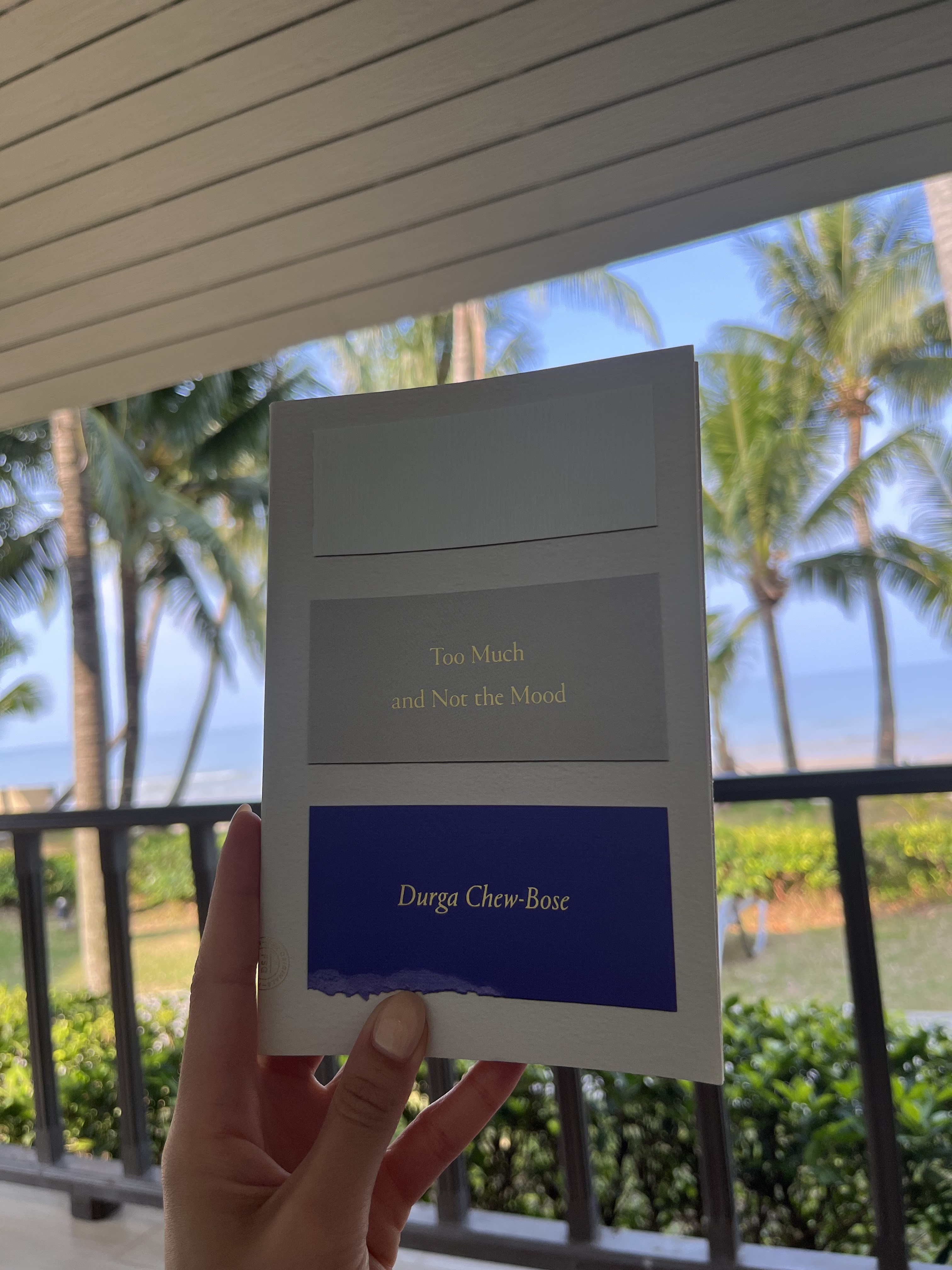
Too Much and Not the Mood
By Durga Chew-Bose
"For twenty dollars—an extravagance I can't afford but can, so in that minute I spend it—we place our palms on metal sensors, have our photo taken with a Kirlian-type camera, and then sit and listen as an employee at Magic Jewelry—who sometimes speaks to us in the first-person plural—interprets the psychedelic colors our aura. Reds and oranges mean one thing—that we've been working too hard, we've been told—and cooler colors signify that we're withdrawn and overthinking, daydreaming and negligent of more earthly forces. Habitually, the both of us are purple. Absent and worn-out. Entombed in thought. A distinguishing quality of the women I love, meaning, none of us are bothered by how infrequently we see one another. We have an arrangement that was never formally arranged. A consideration for turning down invitations. We are happy for the person who is indulging in her space, and how she might merely be spending the weekend unescorted by anything except her own work, which could also mean: she is in no rush to complete much. She is tinkering. She is gathering all the materials necessary for repotting a plant but not doing it. She is turning off the lights and climbing into her head because that's usually the move."
(p. 53)
"The women I love reenter the world so poorly. Their elegance lies in how summarily they'll dodge its many attenuations, advancing alongside the world as if passing their fingers over the rails of a fence and cleverly selecting the right moment to hop over.
They are women who are loveliest when just a little bit haunted or mad as hell on a clear day. Who carefully believe in ghosts and kismet, and are mistrustful of shortcuts. Who laugh like villains. Wake up earliest when the sky is overcast. Who needn't say much for all to know, tonight, they won't be staying out long. Who dip their toes into the current, only to retreat and fantasize about the bowl of cereal they'd rather be scarfing down at home. Who, like my friend Jenny specifically, are hot. Who don't need anyone—including me right now—to depict why. Proximity to hotness can feel like a link to the universe. Your hot friend on a balmy summer night telling you about some good news in her life is—How do I put this without sounding absurd? It's barometric. It's love and someone you love's power growing, and it's watching the elements cater to a woman who exudes."
The best gifts are quiet, unexpected, and exemplary of the most sincere thoughtfulness and knowing. Like this book of essays from my dear friend Kat, which lucky for me served as the best accompaniment for a beach retreat in Koh Chang. When I remember the beginning of this book & becoming instantly immersed and amazed, the sun, sand and waves also line the memory. An eloquent stream of consciousness. I devoured these sentences.
"On the rare occasion my subconscious welds, language has a gift, I've learned, for humiliating those luminous random acts of creative flash into impossible-to-secure hobbling duds. The best ideas outrun me. That's why I write."
(p. 5)
"Even when pointe shoes flit down the stage like muffled hazard. When a fur coat slides off a woman's bare shoulders. Or when a kiss on my neck obscures all clichés about kisses on necks and I am no longer human but merely an undulation."
(p. 6)
"There's strength in observing one's miniaturization. That you are insignificant and prone to, and God knows, dumb about a lot. Because doesn't smallness prime us to eventually take up space? For instance, the momentum gained from reading a great book. After after, sitting, sleeping, living in its consequence. A book that makes you feel, finally, latched on. Or after after we recover from a hike. From seeing fifteenth-century ruins and wondering how Machu Picchu was built when Incans had zero knowledge of the wheel. Smallness can make you feel extra porous. Extra ambitious. Like a small dog carrying an enormous branch clenched in its teeth, as if intimating to the world: Okay. Where to?
"To this day, watching a woman mindlessly tend to one thing while doing something else absorbs me. Like securing the backs of her earrings while wiggling her feet into her shoes. Like staring into some middle distance, where lines soften, and where she separates the relevant from the immaterial. A woman carries her inner life—lugs it around and holds it in like fumes that both poison and bless her—while nourishing another's inner life, many others actually, while never revealing too much madness, or, possibly, never revealing where she stores it: her island of lost mind. Every woman has one. And every woman grins when the question is asked, What three items would you bring to a desert island? Because every woman's been, by this time, half living there."
(p. 32-3)
"There was a period in college when the sound of photocopiers in my library's basement was, I'm uncertain why: blue. Perhaps their ceaselessness reminded me of waves. Paralleling the surf and sway, and roll, on loop. Paper shooting out the tray like lapping ocean water foaming on the beach."
(p. 48)
"The difference between collection and memorial has, in recent years, become less clear to me. My instinct to write things down often feels like obituary."
(p. 49)
"Far more than me, my mother is in touch—or at ease—with flows and overflow, particularly, and contends coolly, unusually so, with spats. For someone so angry about the state of things, fist up and ready to fight the fight, protesting and holding up banners or hanging them from her balcony, making calls on behalf of, hosting conference speakers at her home, showing up in solidarity, unionizing the teachers at her college, my mother does seem, on average, unbothered. There have been times when her disposition is equivalent to that of an email's auto-response away message: a calmly prompt, matter-of-fact no-show. She's there, but not exactly. My mother has proven that a person can be supportive yet remain unreachable, and how the combination has its virtues."
Hi, hello. My 2022 so far has been filled with big decisions, big travel, big feelings. Tons of goodness, overall. This past week was the first time I’ve felt a ::pause:: on the ride, following a slam on the brakes of my own making, and I began to reflect on life’s patterns and the part I play in them. It didn’t necessarily feel good to process the consequence of my imperfections and mistakes and to remember that for all my learnings, I still have a lot of work I need to do to become (better).
I turned here. And if only I’d remembered soonest that I’d developed this space for this very reason—this tiny corner of the internet mostly for me, the equivalent of a nondescript insignificant (sorry, Blogger) but belovedbar located at the end of a hidden alley (I'm picturing a non-threatening one adorned with sparkling lights), that leads to the most comforting worn/torn booth tucked away in the far back, upon whose table lies a collection of wisdom from writers, gathered over 10 years, to help me understand my life. To help me endure and process my own sorrow and self-pity. My joys. My triumphs and growth. My intentions. And when needed, also provide a lift, encouragement, kinship.
In sum: language for me is the balm, the salve, the buoy. Time and time again, an eternal, reliable rescue and guide.
Before I get out of my head and into the city for a solo adventure, an interview with Stevie Nicks. I'm grateful my friend nudged me towards this yesterday. It is grand and affirming and not as good when picked apart so I suggest reading it in its entirety. (Another time I'll need to write about the white-winged doves who made a home in my family's backyard in Houston and the synchronicity of "Edge of Seventeen" also appearing in my life at the same time.)
on living, making the most of your time, and missing Prince:
"And now that he’s gone I’m really just so sorry. My one regret with him is that I did not call him up one day and say, “Listen, I’m just coming in, I’m gonna fly in and come over to Paisley Park and just hang out with you for two days. Because I just would love to see you.” And that’s what I always tell people. Remember, every single day of your life, the people you love could be gone tomorrow. If anybody can take away from what we’re talking about right now, it’s the fact that life is very fragile. You can’t count on ever having a lot of time left."
on spiritual realms, life's signs and where inspiration comes from:
"Yes, absolutely, I do. Because, for me, anything that gives me an idea, it strikes me in the good part of my heart, right? I have other notebooks that are just lying around on my bed, and I’ll just pick one of them to really quickly write that sentence down. I have little things written everywhere, and I try to tear them out immediately and stick them in my journal. So it’s just a feeling of an experience that you had a long, long time ago, and you remember something about it that you hadn’t thought about in a long time."